Silate Diaries.
The questions, ground reality, and inventions behind creating Silate.
I always had a question inside my heart:
Back in those days — in the 16th, 17th, and 18th centuries — inventors and creators built and discovered great things without modern technology, without computers, using only basic offline tools and hard trial.
Today in 2026, in this AI era, we have so many powerful tools in our hands. So why can’t we build something truly great like that?
Back then, I didn’t have the answer. I only had the question.
And that very question was where the journey of Silate — and my own journey — started.
In early 2026, I finished my B.Com (Computer Applications) and PGDCA. I was waiting for a computer / Tally job. My plan was very clear: work only in front of a computer, and never enter a factory floor.
Then, a job came looking for me: Garments Management. I thought, "Let me just go and see how it is for one week."
When I went there, I realized I was the only person in charge. There were no other staff members. From opening the company shutter in the morning to locking it at night, I had to run the whole place alone.
It was a company that showed me every way a business should never be run. Orders were never finished on time. I had to run around visiting job work units, inspecting work, and buying materials and accessories myself. Weekdays or weekends, there was only non-stop tension, urgent orders, and daily friction.
I was stuck right in the middle, taking heavy pressure from both sides, every single day for 2.5 months.
On one side, people trusted only Excel and software. On the other side, people trusted only paper notebooks. Because of this, I had to write every detail three times: once in a notebook, once in an Excel sheet, and once on WhatsApp. It gave me serious tension.
At every month-end, the main branch asked me to submit all accounts. But when I called the units, they would always say: “Wait, I'm checking... the accounts are not matching!”
“In April, during the financial year-end, 6 units and my company struggled for two whole weeks trying to fix mismatched numbers... THAT struggle was the true foundation of Silate.”
After going through all that chaos, an idea hit me: "Why don't I create an Excel sheet myself to solve this whole problem?"
I wanted to make it completely simple and user-friendly. I worked hard for one full week. I organized the entire company management, stock inventory, and job work units into one neat system. I was proud of it, and took it directly to my company owner.
But his response was a cold shock:
“Don’t do anything new... Just follow what is already there!”
My heart completely refused to accept those words. Hearing that made me question everything: "Did I make a mistake coming here? Should I have just gone for that normal computer desk job instead?"
That tension stayed inside me. But instead of giving up, ideas started racing in my mind: "I put so much hard work and thought into this Excel sheet. That effort shouldn't go to waste. Why can't I turn this into real software? Why not build an app so simple that any business owner and staff can use it easily without any training?"
I looked at the market. There were plenty of ERPs already — including Tally, the very software I had waited to get a job for! But there was not a single software built for everyday, casual business owners and staff to handle business operations from A to Z without accounting headaches. That was the moment it struck me: "Why can't I start this as a real business? As a startup?"
Now, I have a personal habit:
“I am a very creative person, ideas come to me constantly... But I never take any idea seriously right away. I let it sit for one full week. Only if that thought is still burning inside my mind after seven days, do I take it as a real, serious idea.”
One week passed. But this idea didn't leave me — it refused to let me sleep. At work, on the road, day and night, it was running constantly inside my head.
So I finally sat down with a pen and paper. I drew a rough sketch of how the UI should look.
“And soon, that rough sketch became the very first digital draft of Silate in Figma — screen by screen, solving every ground-reality problem I lived through.”
 Click to Zoom
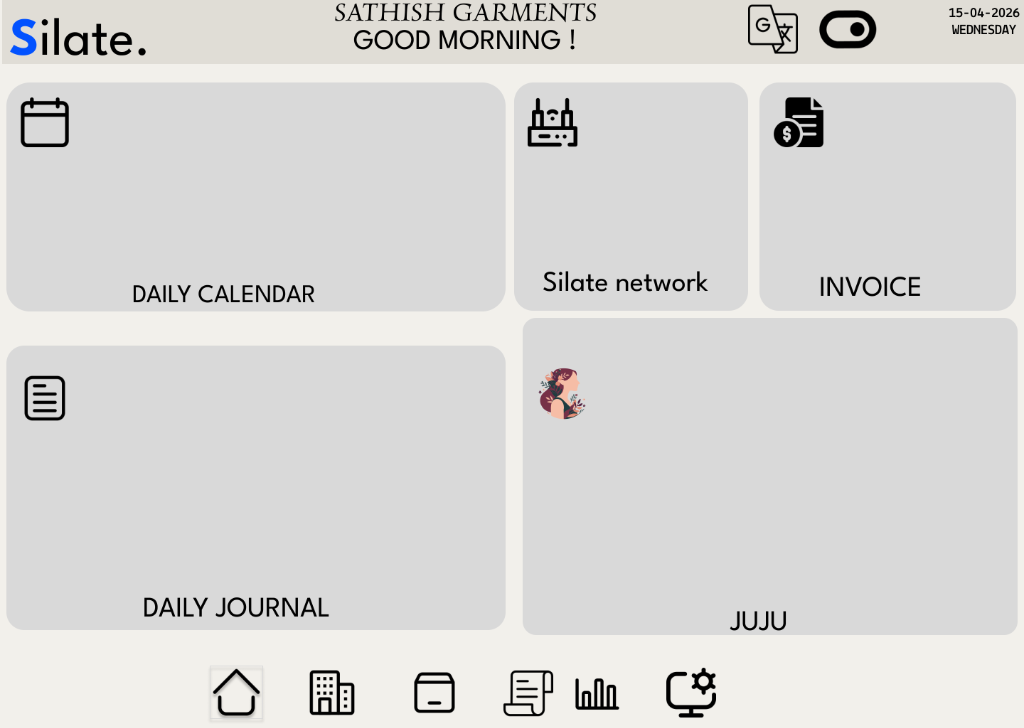
Daily Calendar, Silate Network & Quick Journal
Designed with big, friendly touch cards for the factory owner: Daily Calendar, Unit Network, Instant Invoicing, and AI Assistant (JUJU).
 Click to Zoom
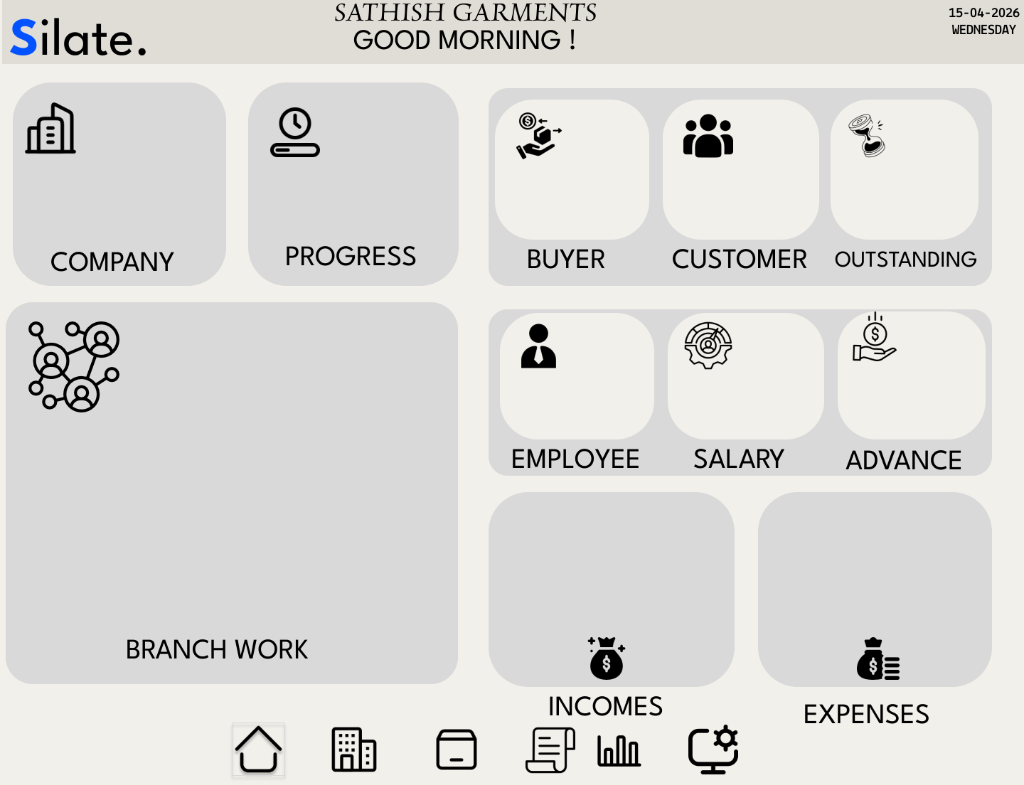
Branch Work, Outstanding, Buyers & Employee Salary
Tracking multi-unit branch workflows, buyer payments, customer dues, salary advances, and live income/expense ledgers in one tap.
 Click to Zoom
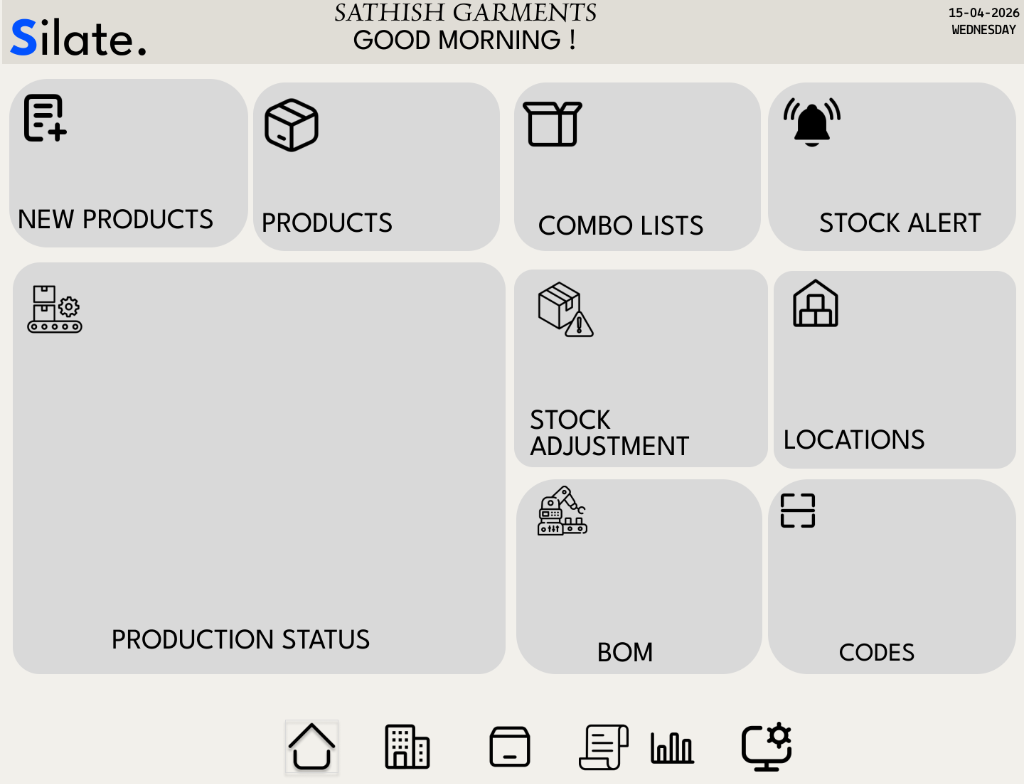
Production Status, Stock Adjustments, BOM & Alerts
Real-time status of garment batches, combo product lists, warehouse locations, stock shortage alerts, and Bill of Materials (BOM).
 Click to Zoom
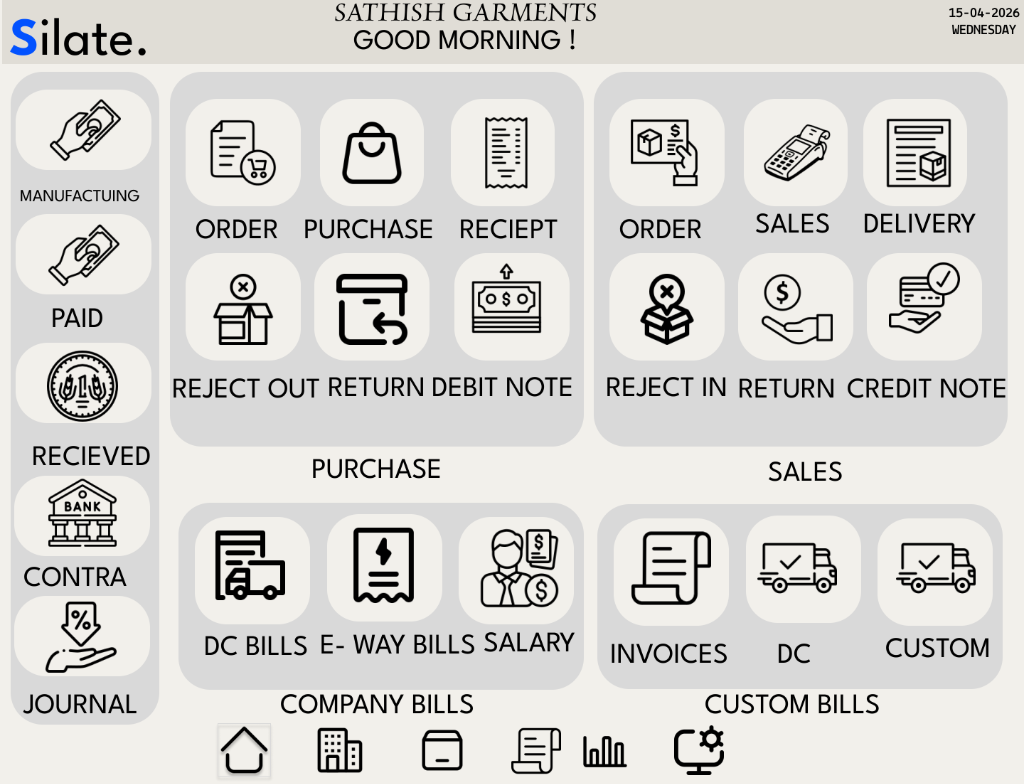
Purchase, Sales, Delivery, DC & E-Way Bills
Managing purchase orders, debit/credit notes, return rejects, delivery challans (DC), and custom company billing workflows seamlessly.
 Click to Zoom
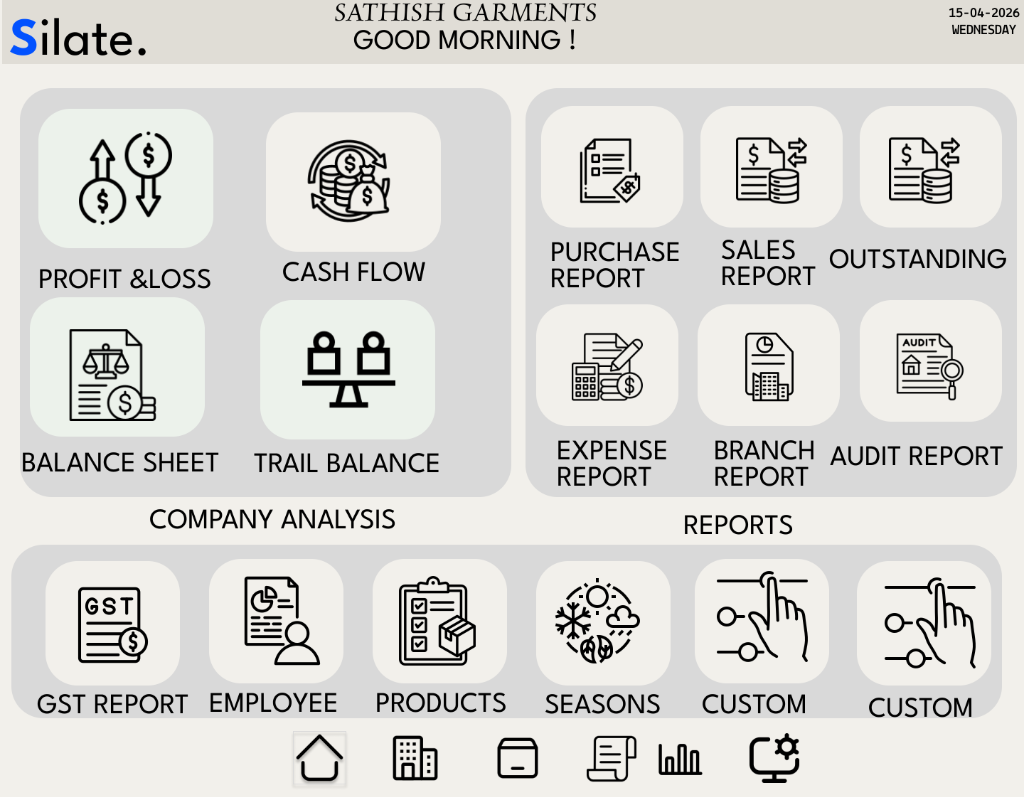
P&L, Cash Flow, Balance Sheet, GST & Audits
Simplifying complex CA reports — instant Profit & Loss, Trial Balance, seasonal sales patterns, and automatic GST breakdown.
 Click to Zoom
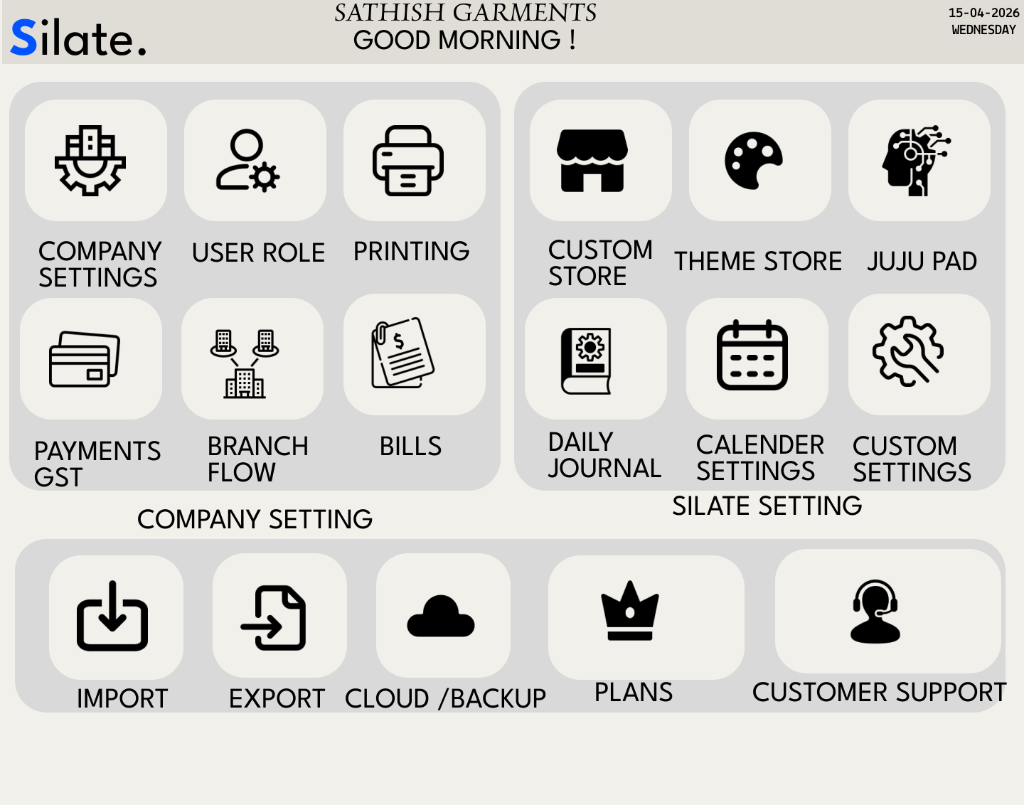
User Roles, Printing, Payments GST & Cloud Backup
Role-based staff permissions, invoice print layouts, branch flow configuration, cloud backup, and custom app themes.
I was still going to my company job every morning. But day by day, that company started fading out of my mind. My head was completely drowned in my own business idea. Day and night, it was running non-stop.
One day, I decided: "It's time to take this seriously. I am going to start building."
I looked at the whole market. There was not a single, complete ERP built for mobile. Everything was built for old desktop computers. So I made a firm decision: we must build seamlessly for both Mobile and Desktop. And for that cross-platform power, Flutter was the choice.
Then came the cold slap of reality:
“I had zero coding knowledge. I graduated in B.Com (Computer Applications), but I had no software development background, no technical mentor, and no big industry contacts.”
My first thought was: "Let me spend 2 full years learning Flutter and Dart properly, and then come back to build this."
Right around that time, the concept of "Vibe Coding" and autonomous AI agents started becoming popular. My interest exploded: "Why should I waste two valuable years just memorizing syntax, when we can build directly with AI agents?"
Then reality hit again: the agent token costs were far too expensive. As a bootstrapped beginner with no money, I couldn't afford burning cash like that.
So I told myself: "Fine, let me at least learn the core basics of Flutter and Dart myself." I sat down and studied hard for two weeks. But it was very complex and frustrating. I stopped and asked myself:
“If I am struggling this much just on the basics, how am I going to build a massive, end-to-end ERP all by myself?”
That was the turning point. An audacious idea struck my mind:
“Why don't I create my own programming language? A language designed around how I think — simple, natural, and friendly. A transpiler engine: where I type in my own easy syntax, and my engine automatically translates it into clean Dart code!”
I named this language and engine: JUJU.
Remember the question I asked in my very first diary entry?
“In the 17th and 18th centuries, inventors created revolutions with zero technology. Today in 2026, when we have AI as the ultimate superpower weapon in our hands... if we just walk past without daring to invent something bold, who is a bigger fool than us?”
I designed the core fundamentals of JUJU — how the syntax should look, how variables and functions should behave, and how it translates into Dart.
“My long-term vision was to make JUJU the permanent brand identity of Silate — our company's very own proprietary programming language in the future. And looking at the incredible potential of modern AI, I knew that dream was genuinely achievable.”
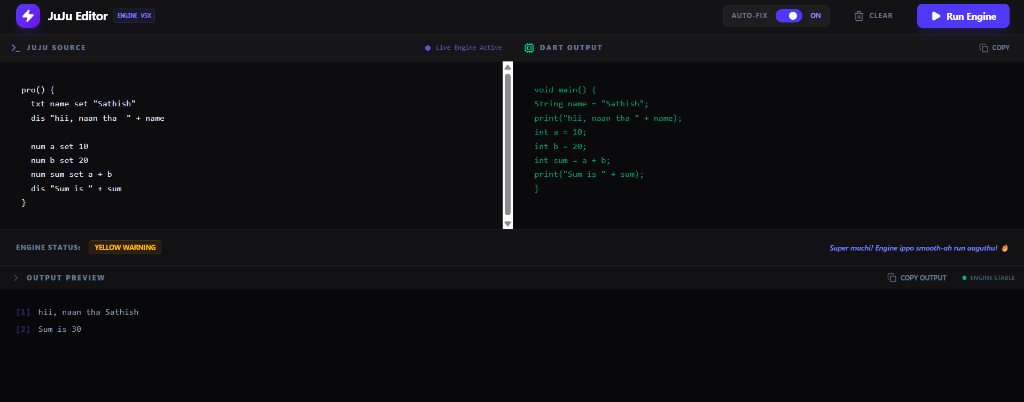
To test this idea on a small scale, I experimented and built my very first working prototype: The JuJu Editor & Transpiler Engine.
 Click to Zoom Full Screen
Custom Transpiler Converting Human Logic Directly Into Production Dart
Built by Sathish Kumar J: writing natural syntax (pro(), txt set, num set, dis) that the JuJu Engine V5X automatically compiles into structured Dart void main(), String, int, and print() in real-time.
Seeing JuJu actually compile and run proved the concept. But immediately, the next big reality hit me:
“Everyone told me: ‘A browser chat window is fine for small scripts and simple experiments. But to build a massive, complex enterprise ERP with hundreds of interconnected screens, you strictly need a professional IDE!’”
So I started searching and digging deep into the development world. That was when I discovered Google Antigravity! And the game-changing revelation was: Antigravity runs natively and autonomously on the Google Gemini ecosystem.
The very next minute, my master plan snapped into place. I mapped out a smart, zero-cost AI setup:
“Overall, across those 8 months, I had assembled over ₹41,000+ worth of enterprise-grade AI power right on my machine — completely free, without spending a single rupee.”
With that superpower unlocked, I sat down and mapped out everything:
With that complete blueprint in my head, a battle-ready autonomous IDE on my screen, and JUJU in my hands...
I quit my company job. The real journey of Silate began.
Once I jumped full-time into development, I set one non-negotiable core rule based on Tiruppur’s ground reality:
“The 10-Minute Adoption Rule: Any business owner or casual staff member should open Silate and understand full business management within 10 minutes — without any training, manuals, or computer courses.”
That was the only way to reach real MSMEs. Large corporations spend lakhs of rupees on SAP, Oracle, or heavily customized enterprise software. They were never our target. Silate is fiercely built for the neglected 99% — the local factories, retail stores, job-work units, and traders.
As I went deeper into designing the workflows, a massive realization hit me:
“This chaos wasn't just a garments problem! Any business that handles physical products — retail, wholesale, hardware, textiles, manufacturing — suffers from this exact same stock mismatch, delayed payments, and coordination nightmare.”
That meant Silate could never be a generic, one-size-fits-all app built inside an AC room. Having seen real business struggles firsthand with my own eyes, a completely unique angle struck me. What I directly observed on the ground was totally different from what conventional software builds — and combining those raw ground-level observations with deep research revealed how work actually needed to move.
Then, I studied human psychology in everyday retail and business:
When sales are buzzing, owners work actively. But during dull hours or off-seasons, owners sit idle and waste hours scrolling social media reels. I asked myself: "Instead of wasting free time scrolling reels, how can Silate help them use that idle time to actually grow their business?"
“Why not hit three birds with one stone?
1. Management: Zero-stress billing, stock, and accounting.
2. Market Intelligence: Ground market rates and cheaper material sourcing.
3. B2B Trade & Unions: Silate users connecting to trade collectively!”
I expanded this into a living ecosystem:
Beyond individual connections, businesses can form industry groups and unions directly inside Silate. They can trade surplus inventory, share wholesale orders, and run end-to-end CRM — all inside one unified system.
And here is a raw, honest truth about human nature:
“Many people are prone to laziness or procrastination — and including myself, I am one of them! If software demands five extra clicks, people abandon it. That's why Silate is designed with ZERO cognitive friction. When an owner sees work finishing at lightning speed and new business flowing in, they will never hesitate to pay an affordable subscription.”
This led to my biggest market observation: The Tally Lesson.
Why did Tally dominate India for 30 years? Because they captured an entire generation of Chartered Accountants (CAs). The CAs forced businesses to adopt it. But the harsh reality is that everyday business owners never truly loved Tally — they only suffered through it because their accountant demanded it.
Silate bridges both sides:
“An effortless 10-minute app that the store owner and staff genuinely love using every single day — which automatically generates the exact GST, P&L, and Audit reports the CA needs with a single tap.”
If our software is to stand tall in the market, it cannot just be another pretty tool.
It must solve real, raw business problems from the ground up — and build a self-sustaining ecosystem where every MSME thrives.
Then, I dove headfirst into development. First, I built the desktop prototype. Over the next 3 months, I adapted and built the mobile app. Many technical hurdles, bugs, and crashes showed up along the way, but I solved them one by one.
Everything looked clean. The app was simple, straightforward, and business owners could easily navigate it. But right when things seemed ready, a sudden question hit me like a lightning bolt:
“Wait... even after all this work, aren't I still making the user do the exact same manual entry work they did in the old software? How much time they wasted there, they are still spending here! Right now, am I just optimizing comfort for the auditor while ignoring the true comfort and freedom of the business owner?”
I sat down with a paper and pen to calculate the brutal reality of an everyday shop or factory:
To make a single bill with an average of 30 items takes about 5 minutes. Even with barcode scanners, it takes at least 3 minutes.
Now look at both sides of trade: The Buyer and The Seller.
The seller takes 5 minutes to type the sales bill. In Tiruppur’s real-world workflow, there is also the delivery challan, gate-pass, and stock deduction. Then the buyer receives that paper bill, sits down at their computer, and spends another 5 minutes re-typing the exact same 30 items into their own software as a purchase entry.
That is 10 minutes burned on a single transaction across both parties!
5m seller typing + 5m buyer re-typing identical items.
For just 30 everyday sales bills across partners.
Nearly 1.5 full working days burned re-typing numbers.
15.6 full working days vanished into pure manual entry.
7.5 full working months of a human life lost forever.
Look at that number again: 1,500 hours a year wasted re-typing what another human being has already typed!
That was the true breakthrough. I realized what Silate actually needed to be:
“A bill should never be typed twice in its lifetime! If the seller enters it once, why should the buyer ever touch a keyboard again? In less than 1 minute, the seller's sales bill must automatically become the buyer's purchase bill. One single entry updates inventory, ledgers, and GST filing for both sides simultaneously.”
I locked myself in and built this connected zero-re-entry domino engine directly into Silate.
The first day I tested it with live transactions... I couldn’t believe my own eyes.
Words cannot describe the sheer joy and relief I felt at that moment. Avlo santhosam!
All those lonely nights, skipping meals, fighting family doubts, and betting everything on an unproven dream — none of it had gone to waste. The vision was real. The system worked flawlessly.
But right in the middle of that euphoria, a deeper responsibility took over:
“I cannot stop here. If I celebrate and stop now, Silate will never grow into what it is truly destined to become.
Silate cannot just be software. It must be a complete experience. A launchpad where individual talented people, craftsmen, and small producers can thrive without being crushed by giants.”
That night, I didn’t just think about the next release. I mapped out my life’s work — a 40-Year Master Vision to solve an entire civilization-level ecosystem:
Silate Core & Global Expansion
Anchor the product deeply in Indian MSMEs first, establish undeniable ground truth, and expand internationally across emerging global trade clusters.
Manufacturing Sector Integration
Step into direct production units, equipment support, raw material supply lines, and factory-floor optimization to power grassroots makers.
Global Logistics & Freight Pipeline
Solve the movement of goods end-to-end. Seamless transport, real-time routing, and zero-delay supply pipelines connecting factories to markets.
Human Rejuvenation & Tourism
Businesses are run by living human beings. When work pressure burns them out, provide dedicated tourism, wellness, and mental rejuvenation for founders and workers.
High-Impact Services & Entertainment
The ultimate lifetime goal: creating a flourishing ecosystem spanning life, culture, entertainment, and meaningful human services where people truly thrive.
If I can solve this entire chain from raw goods to human well-being, only then will I feel that my life’s work is complete.
Silate is not just a software startup. It is the beginning of a lifetime journey to build an ecosystem where honest, hard-working people finally win.
Now, we have arrived at the most critical stage of this entire journey.
For everything we envisioned — the connected ecosystem, the 10-minute adoption, the zero-re-entry domino engine, and the 40-year horizon — to become a living reality on the ground, the full production version of the Silate app must be built and placed into the hands of real business owners.
To take Silate into this next stage, we are officially opening our initial funding round. Here is our disciplined, realistic execution roadmap:
Capital & Core Team Setup
Closing our initial seed funding and assembling a passionate core engineering and grassroots operations team right here in Tamil Nadu.
1-Year Dedicated Build & 5-Industry Live Pilots
Silate is not just for garments — it is engineered for any business managing physical products. Based on deep offline field research, we have chosen 5 Core Product Industries for our Phase 1 Plan: running a disciplined 1-year build phase with live pilot deployments inside active factories, wholesale hubs, and retail stores with zero compromise on speed and stability.
Official Public Launch
Releasing Silate to the wider Indian MSME market and beginning the rollout of connected B2B trade, stores, and zero-re-entry billing.
I have absolute clarity on why I am building this company, and I live by one fundamental rule:
“Customer-க்கு profit வந்தாத்தான் எனக்கும் profit வரும். அது எனக்கு நல்லாவே தெரியும்.”
“Only when our customers make a real profit and save valuable hours of their lives does Silate deserve to make a profit. I know this truth deeply.”
I promise with full conviction that Silate’s marketing and apps will never disappoint you. They are designed from the ground up to bring direct, measurable benefits to your everyday business.
To every visitor, investor, developer, and business owner who took the time to read my story from Entry 01 to this final page:
Thank you so much from the bottom of my heart.
Knowing that someone out there is reading this gives me immense strength to keep fighting. I will definitely start Silate's full development within this year — I have unwavering faith in this mission.
Stay tuned — I will keep updating this diary with our engineering progress, milestones, and behind-the-scenes breakthroughs in upcoming blog entries.
Yours sincerely,